
SAFEs & convertibles
To put a signed SAFE on your cap table, open Cap Table → Update and choose SAFEs (outstanding). Tenacap records its terms, can generate a Y Combinator post-money SAFE for signature, and converts every outstanding SAFE in your round model so you can see the result before you sign a term sheet.
A SAFE (Simple Agreement for Future Equity) is a promise to convert into shares at your next priced round, on terms agreed now. Until it converts it holds no shares: it is listed on the cap table’s Convertibles & SAFEs tab and is not part of fully diluted.
Record a SAFE
Under Cap Table → Update, in the Issue group, choose SAFEs (outstanding) (editors and admins). If the investor is not on your cap table yet, add them as a stakeholder first. The form asks for:
- Investor - the stakeholder putting in the money.
- Investment - the purchase amount, in dollars.
- Valuation cap - optional.
- Discount - optional, as a percent (
20for 20%). A discount of 100% or more is refused. - Cap type - Post-money (the current YC form) or Pre-money (the original YC form). Nothing is chosen for you: the SAFE’s first page says which, and YC’s post-money SAFE came out on 28 September 2018, so a SAFE signed before then is usually pre-money.
- Issue date.
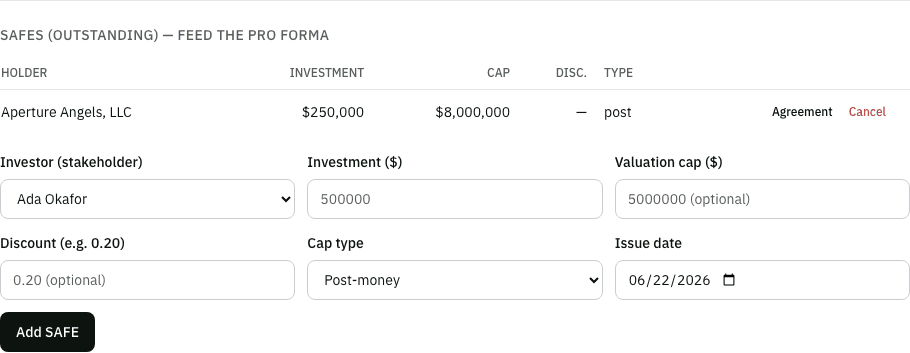
This form records SAFEs only. An import or a connected assistant can also bring in a SAFE with a most-favored-nation (MFN) term, which this form does not offer.
An import reads whether a SAFE is post-money or pre-money when the file says so. Carta exports usually do not. A Pulley export does when it has a Conversion Type column, which some do and some do not. A capped SAFE whose file does not say is treated as post-money and marked post-money (assumed), and the cap table and the import summary ask about it, with Post-money is right and It is pre-money to record the answer in one click. It matters for SAFEs signed before late 2018, when YC’s form was pre-money: a $1,000,000 SAFE at an $8,000,000 cap on 8,000,000 shares converts into 1,000,000 shares pre-money and 1,142,857 post-money. The agreement says which: a post-money SAFE names a “Post-Money Valuation Cap”. In a Tenacap CSV, a Cap Basis column or a Security Type of Post-Money SAFE or Pre-Money SAFE states it. A SAFE imported before Tenacap asked, dated before 28 September 2018 and not edited since, is asked about the same way, unless its file stated the form. So is a SAFE entered by hand before Tenacap asked the form, whatever its date, unless it has been edited since. One added in the guided setup was dated your incorporation date, so check its date against the agreement too.
Record a convertible note
Next to the SAFE form, Convertible notes (outstanding) records a note the company has issued: the principal, an annual simple-interest rate, a day-count basis (Actual/365, Actual/360 or 30/360), an optional valuation cap and discount, a maturity date, and the issue date. The rate and the discount are typed as percents: 7 for 7% interest, 20 for a 20% discount. Until now only an import could put a convertible note on the cap table; this form and the equivalent assistant tool are the manual-entry path.
A note holds no shares until it converts, the same as a SAFE, and it is listed on the Convertibles & SAFEs tab alongside your SAFEs. Interest accrues from the issue date at the recorded rate and basis; recording the note shows what has already accrued as of today, and the priced-round close accrues it the rest of the way to the close date before converting principal plus interest. Tenacap does not yet model what happens if a note reaches its maturity date unconverted (repayment or extension), or an MFN term on a note; both are handled by hand for now.
A note can also carry a change-of-control multiple: what it repays if the company is sold before the note converts, as a multiple of principal plus interest (“1.5” for 1.5×). At a sale the holder gets the greater of that repayment or converting at the cap, and the exit waterfall shows which it chose. Leave it blank and 1× is assumed. Edit terms on a recorded note corrects its multiple, cap, discount, interest rate or maturity date, which is how an imported note gets its multiple; principal, holder and issue date are corrected by cancelling the note and recording it again.
A note’s cap is either pre-money or post-money, and the note says which. Pre-money divides the cap by the company’s fully diluted shares before the notes and SAFEs convert. Post-money counts their conversion shares too, the way a post-money SAFE does, so the note owns its principal plus interest over the cap of the company (5% for $265,000 on a $5.3M cap) and converts into more shares. Set it with Cap is when you add the note or under Edit terms. A note that does not say, which includes every imported note, is treated as pre-money, and the exit waterfall and the round close say “pre-money assumed” so you can check it.
Either way, a note’s fully diluted count includes the option pool. In a priced round that means the unissued pool and the increase the round makes to it; at a sale, the unissued pool. That is how the standard note form (the Angel Capital Association’s model convertible note) defines it, and it is the opposite of a post-money SAFE, which leaves the round’s increase out. A bigger count means a lower cap price, so the note converts into more shares. If your note leaves the increase out, set Round’s pool increase in the count to Left out under Edit terms. Until you set it, the pro forma and the round close say the increase was included as an assumption.
Every outstanding note is listed under Cap Table → Structure → Convertible notes, grouped by note issue, with Edit terms on each; a holder’s page links straight to it. Tenacap treats notes as one issue when their cap and its basis, discount, interest rate, maturity date and change-of-control multiple all match (a rolling close issues on several dates, so the date is not compared). Before you save, the form says how many holders the change reaches and applies it to the whole issue; untick the box to change one holder’s note only. Each note keeps its own entry in the change log.
A SAFE’s terms are corrected the same way, under Cap Table → Structure → SAFEs: its valuation cap, discount, whether it is the post-money or pre-money form, and its MFN and pro rata rights. Investment, holder and date are corrected by cancelling the SAFE and recording it again. The edit changes the one SAFE unless you tick the box to change every SAFE with the same terms; two SAFE rounds at the same cap look alike, so that box starts unticked.
How a SAFE converts
At a priced round, each SAFE converts at the lowest of the prices its terms allow, which is the one most favorable to the investor:
- Cap price - the valuation cap divided by the company’s capitalization (below). Only a SAFE with a cap has one.
- Discount price - the round price less the discount. Only a SAFE with a discount has one.
- Round price - always a candidate, so a cap above the round valuation never binds and the SAFE converts at the round price, as the YC form says. A SAFE with neither a cap nor a discount converts at the round price.
The shares a SAFE becomes are its investment divided by that price, rounded down to a whole share.
Generate a YC post-money SAFE
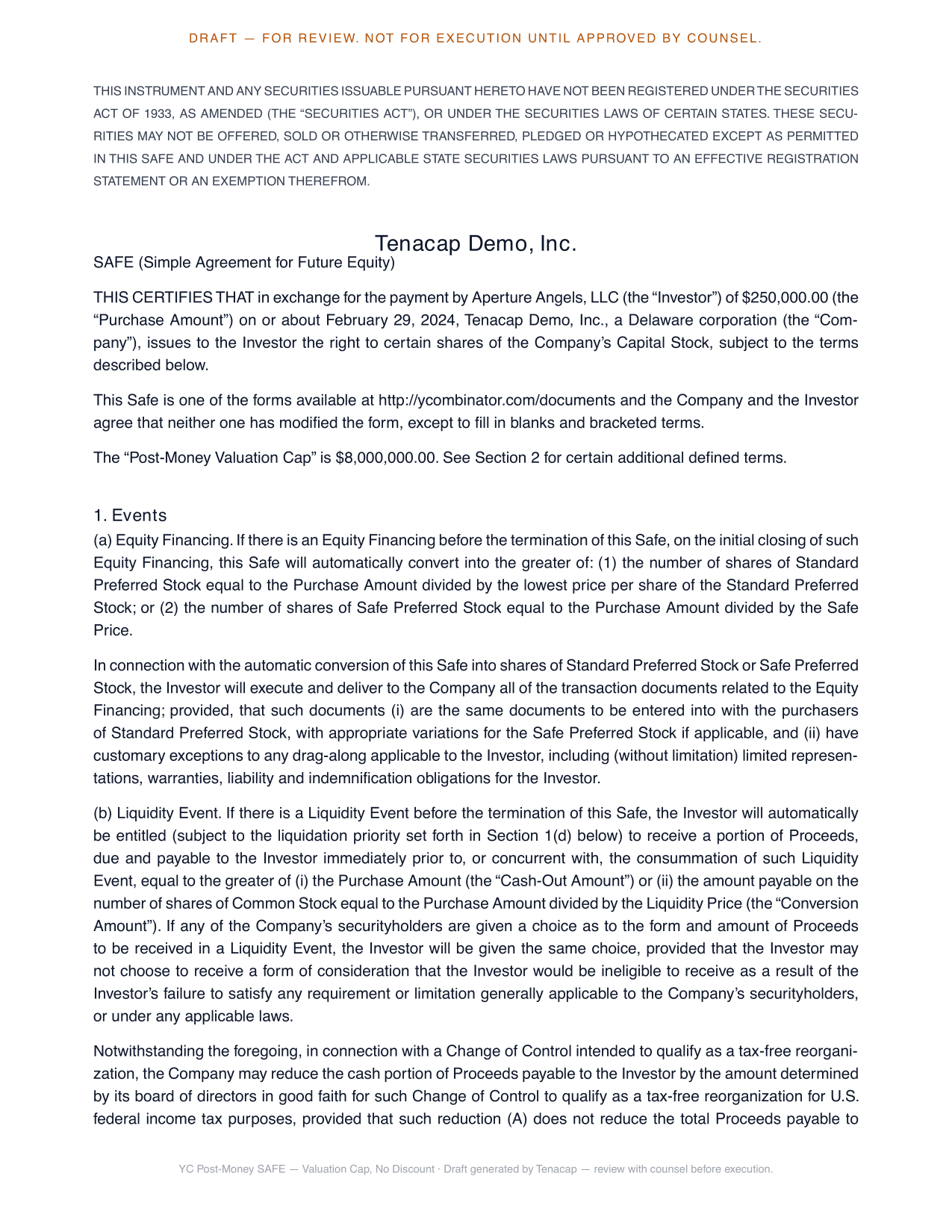
If the SAFE is not papered yet, Tenacap can generate it from the official Y Combinator post-money form, with your company name, state of incorporation, investor, amount, cap, discount and date filled in. The legal body is the unmodified YC text. Four variants are available:
- Valuation Cap, No Discount
- Discount, No Valuation Cap
- Valuation Cap and Discount
- MFN, No Valuation Cap or Discount - for an MFN SAFE recorded with neither a cap nor a discount.
Click Agreement on the SAFE’s row to preview the PDF. A pre-money SAFE, and a SAFE with no cap and no discount that is not MFN, can be recorded but has no generated document.
Send it for signature
From the same Agreement panel, request the investor’s signature. The investor gets an email with a signing link, and the executed copy comes back sealed with a signature certificate you can download. The full flow is in Documents & e-signature.
How SAFEs feed scenarios
The round pro forma in scenario modeling starts with a row for every outstanding SAFE, and each converts on its own terms as described above. You see what each SAFE turns into, how the new money dilutes everyone, and where the founders land. When the round closes, recording it converts the SAFEs and notes you tick.
Techstars CEA and other fixed-percentage convertibles
Techstars, like some other accelerators, invests through a convertible equity agreement (CEA) that buys a fixed percentage of the company instead of shares at a price. Its published investment terms pair a CEA for a percentage of common stock with a separate uncapped MFN SAFE. A CEA is neither a SAFE nor a convertible note: it has no valuation cap, discount, interest or maturity date.
Tenacap records it as convertible equity (fixed percentage). To record one (editors and admins), open Cap Table → Update, choose SAFEs (outstanding), set Instrument to Convertible equity (fixed percentage), and enter the investor, the purchase amount, the percentage, the equity financing threshold (the smallest priced round, in new money, that converts it) and the date. For example, $25,000 for 4% with a $250,000 threshold. It shows as Convertible equity (4%) wherever its terms are listed. Record the separate SAFE on its own terms; for an uncapped MFN SAFE, tick MFN (most favored nation) under Edit terms (see the MFN note above).
How Tenacap converts it:
- At a priced round whose new money meets its threshold, it becomes common stock in the founders’ class: its percentage of the company capitalization measured just before the round. That count includes the CEA’s own shares, the converting SAFEs and notes, options and the unissued pool, and leaves out the new money and the round’s pool increase. Fractions of a share round up. The new money then dilutes it like any common stock. A round below the threshold does not convert it.
- At a sale, a listing or a wind-down before a priced round, it becomes its percentage of common stock, counted without the unissued pool and without any SAFE that takes its money back instead of converting. It gets no money back first and sits with common, not with the SAFEs.
- Tenacap does not offer a YC SAFE agreement for it. Your signed CEA is the agreement.
If a fixed-percentage agreement is on your cap table as a SAFE, change it rather than recording it again: open Cap Table → Structure → SAFEs, click Edit terms, set Instrument to Convertible equity (fixed percentage), enter the percentage and the threshold, and save. Saving clears the cap, discount and MFN it had as a SAFE.
From Pulley. Pulley has no fixed-percentage type. It lists a Techstars CEA with the SAFEs, under an id that starts TCN-, and records the percentage as a valuation cap of the amount divided by the percentage. An import brings such a row in as convertible equity and reads the percentage back from that cap: $30,000 at a $500,000 cap reads as 6%. Pulley does not record the equity financing threshold, so the import summary asks you to set it under Edit terms; until then a priced round does not convert it. A TCN- row dated before April 17, 2025, the earlier form, or one whose cap gives no clean percentage comes in as a SAFE, with a note saying so.
Your agreement governs. This section describes these agreements in general, and yours may differ. It is not legal or tax advice.
To keep the signed agreement in Tenacap (editors and admins), use either of these:
- On the investor’s page. Open Stakeholders and click the investor. In the Documents card, choose the PDF, change the kind from Other document to Signed SAFE or convertible note, and click Attach document.
- From the Documents page. Open Documents, click Import documents, then Choose files or a .zip and pick the PDF. In the table, set What it is to SAFE and Attach to to the SAFE you recorded for the CEA, or to Company files. Then click Confirm and attach 1 file.
Where a converted holding came from
Once a SAFE or note converts, either when you record a priced round or in an imported cap table where it already converted, the resulting preferred shares show their lineage. On the shareholder’s page each holding names the SAFE or note it converted from, so you can trace any block of preferred back to the original instrument. Pulley imports bring these conversions in, and each note links to the certificate it became.